
Seah Eu Chin’s Mansion at North Boat Quay
After he had acquired his wealth, Seah Eu Chin lived in a mansion built by his son Seah Cheo Seah. This grand residence was renowned as one of the “Four Great Mansions” of 19th-century Chinese community leaders in Singapore.
The historical “Four Great Mansions” were:
(i) Seah Eu Chin’s mansion at North Boat Quay;
(ii) Tan Seng Poh’s mansion at the corner of Hill Street and Loke Yew Road;
(iii) Wee Ah Hood’s mansion at Hill Street, where the Singapore Chinese Chamber of Commerce and Industry stands today; and
(iv) Tan Hiok Nee’s mansion at Penang Road.
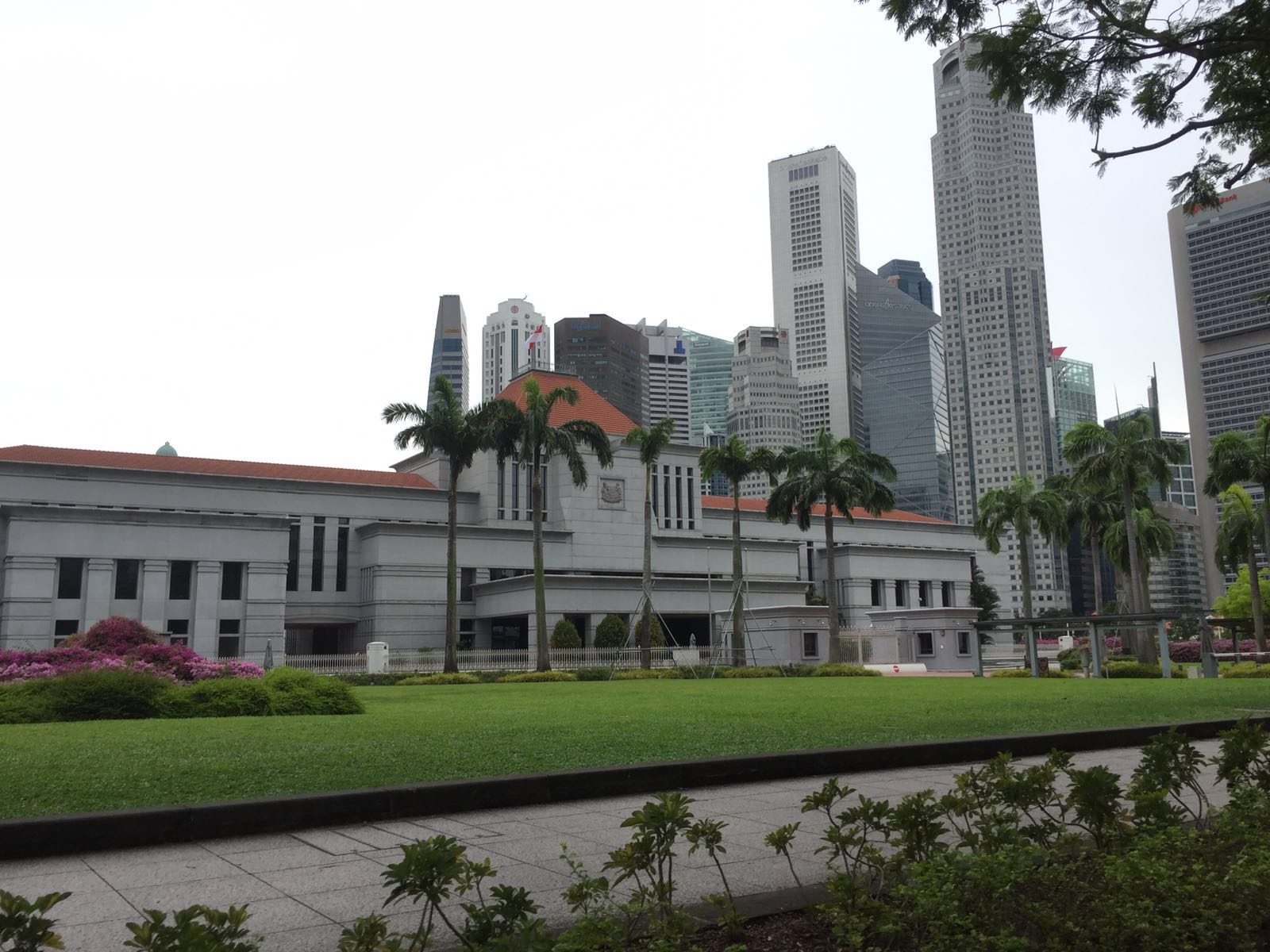
The field in front of Singapore’s Parliament House is the site of Seah Eu Chin’s former mansion. Photograph by author Shawn Seah.
Located along North Boat Quay, the site where the House of Seah Eu Chin once stood is currently the field situated in front of the Singapore Parliament House. This historic site was once at the heart of Singapore’s bustling trading area.
Seah Eu Chin’s house stood on a plot of about 18,700 square feet, which the family sold in December 1918, according to Chantal Sajan from The Straits Times.
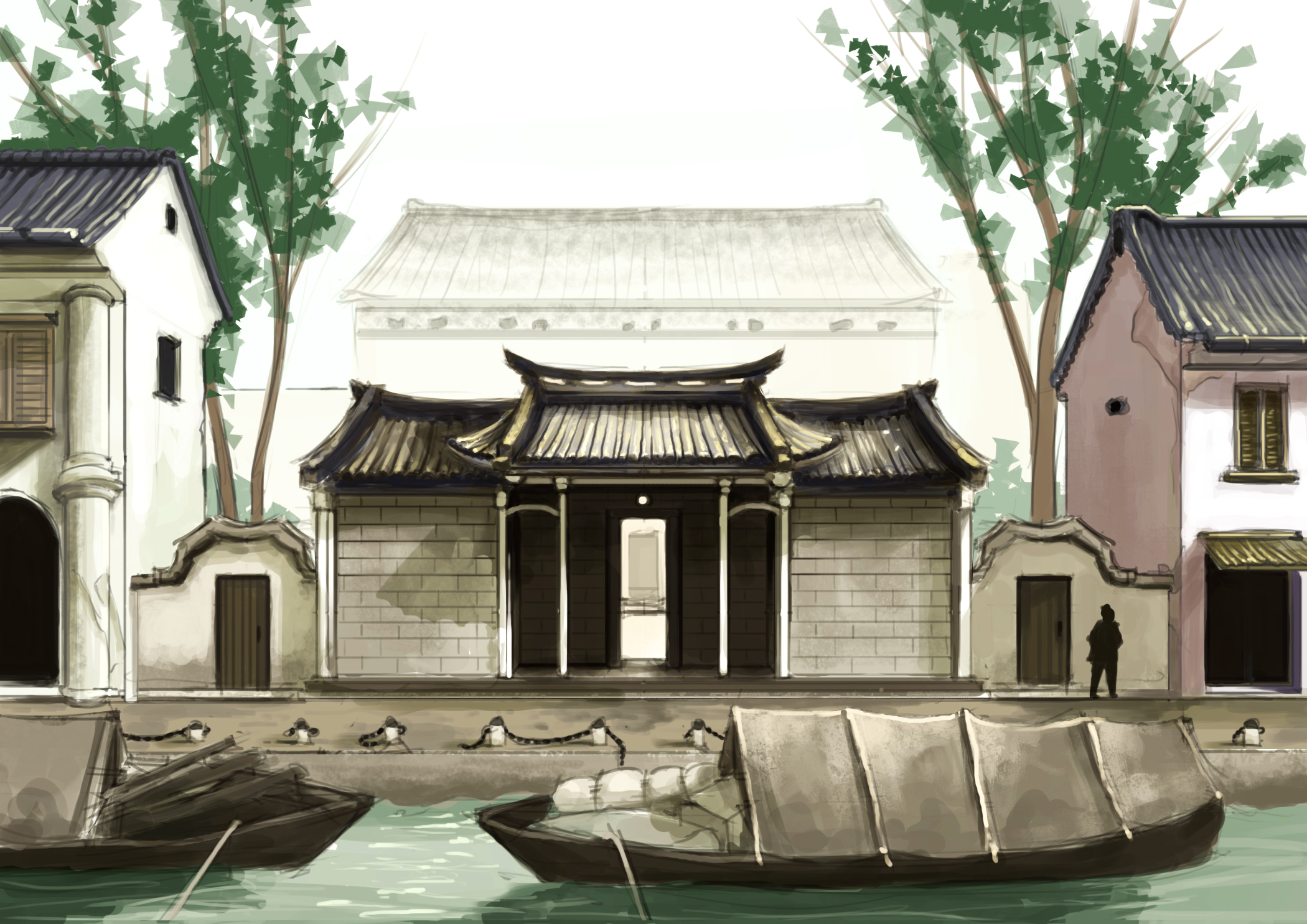
An artist’s impression of the entrance to Seah Eu Chin’s house at North Boat Quay. Artwork commissioned and owned by author Shawn Seah.
This illustration shows an artist’s impression of the grand entrance gate of Seah Eu Chin’s highly ornate, ostentatious house, one of the Four Great Mansions in Singapore. The entrance gate opened up to an inner courtyard.
Seah Eu Chin passed away at eight o’clock at night, on 23 September 1883, in his beautiful mansion at No. 11 North Boat Quay. He was 78 years old, one of the oldest Chinese residents in Singapore at the time.
To read more on Seah Eu Chin’s life and times, please click here: Seah Eu Chin.
Seah Liang Seah’s Bendemeer House
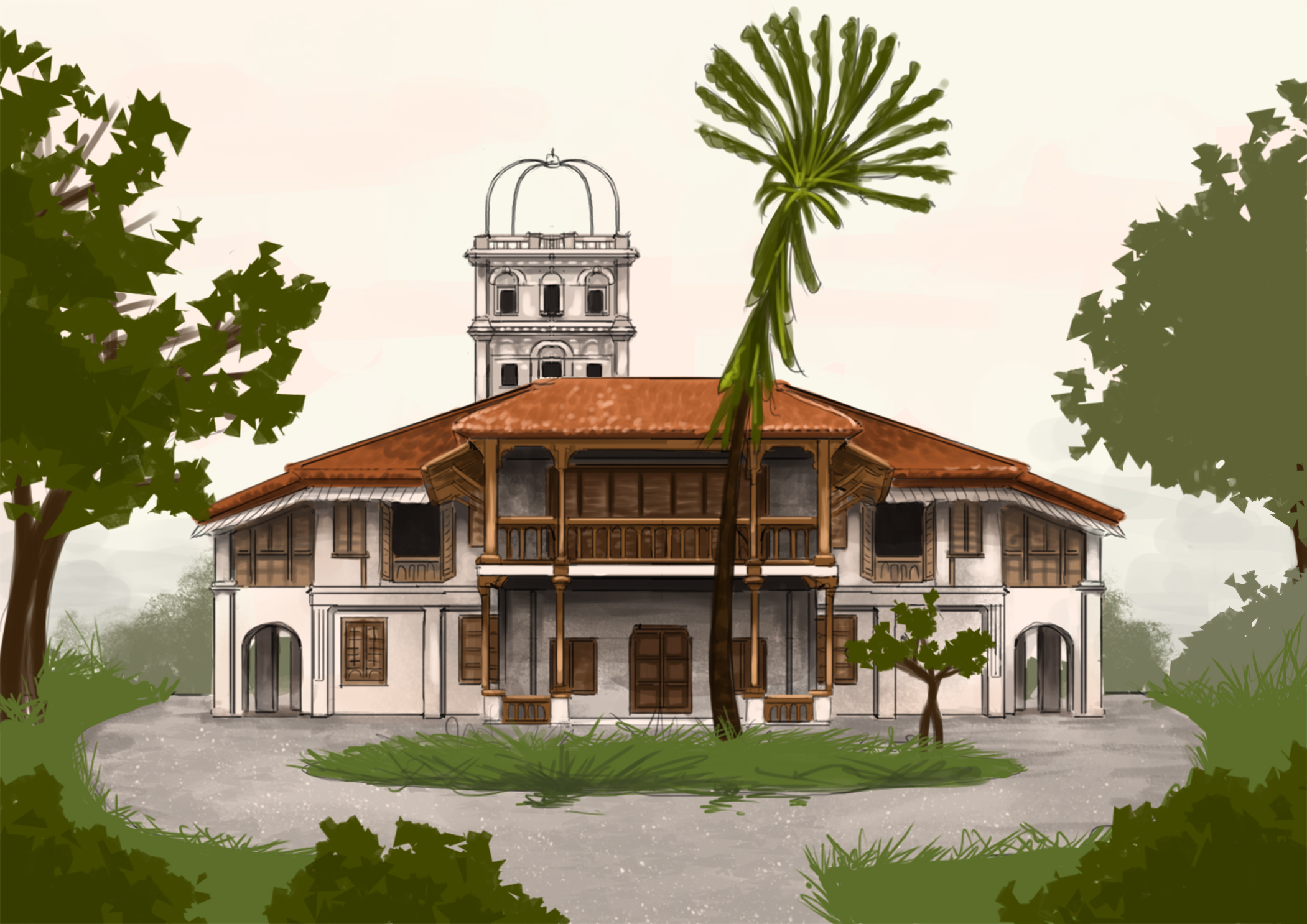
An artist’s impression of Seah Liang Seah’s Bendemeer House. Artwork commissioned and owned by author Shawn Seah.
Seah Eu Chin’s children also owned grand and famous houses of their own.
In 1895, his second son Seah Liang Seah officially opened his residence, Bendemeer House, to around 500 leading residents of Singapore, both Chinese and European.
For more detailed information on Seah Liang Seah, please click here: Seah Liang Seah.
How Did Bendemeer House Come to be Named This Way?
Originally, the house was known as Whampoa House or Whampoa’s House, but it was renamed by Seah Liang Seah.
Various speculations surround the origins of the name Bendemeer.
In March 1895, a writer for the Singapore Free Press and Mercantile Advertiser speculated that the “romantic name” of Bendemeer was the suggestion of the Governor, likely referring to W E Maxwell, who was then-Acting Governor (1893 – 1895).
In August 1936, another writer, writing for The Straits Budget, suggested that the name of the house was from a poem by Thomas Moore, namely: “There is a bower of roses by Bendemeer’s stream/ And the nightingale sings round it all day long“.
And according to a conversation between writers Ng Yew Peng and Kua Bak Lim, Kua was of the view that Bendemeer could have been the name of a song, since Seah Liang Seah was a music lover.
No one knows the true reason.
These suggestions are all fascinating, but I adopt a different view that is relatively more common among Seah descendants.
As far as I understand it, the term Bendemeer is likely a transliteration of the Teochew dialect term for the Chinese characters of ming li yuan, literally a bright and beautiful garden, which it certainly was.
What Did Bendemeer House Look Like?
The majestic two-storeyed mansion consisted of frontal and rear wings which branched off from the center spine, which had a large ballroom.
The ground floor in the mansion was built with stone tiles but the flooring on the upstairs was timber.
There was a four storey tower at the rear of the house, which could be accessed from the second floor through a series of side rooms.
The top of the tower had to be reached through an iron spiral staircase.
It was a massive and stately house with few parallels during the time.
Parties at Bendemeer House
In 2019, Straits Times heritage and community correspondent Melody Zaccheus wrote an article titled “Singapore’s Original Crazy Rich Asian”. It was on Seah Liang Seah.
She was right: Seah Liang Seah was indeed one of Singapore’s original crazy rich Asians.
A most colourful character and engaging host, Seah Liang Seah hosted many exciting parties at Bendemeer House. He would make guests participate in activities, including miniature rifle shooting, guessing games, and even whistling competitions where the whistler had a biscuit in his mouth while a teammate guessed the song!
The Singapore Free Press and Mercantile Advertiser reported on 10 February 1909 that:
Mr. Seah Liang Seah, the doyen of Straits-born Chinese, held a most successful “At Home” at his fine house, Bendemeer, Sirangoon-rd [sic], yesterday afternoon. The house and grounds are always worth looking over, and as the afternoon was beautifully fine, till quite late, the proceedings were animated and successful.
Early in the proceedings the large company was photographed on the lawn. Among the guests were His Excellency the Governor, His Excellency Major General Perrott, and Mrs Perrott; Sir W. Hyndman and Lady Hyndman Jones; Sir Arthur and Lady Evelyn Young, &c. A large number of Chinese towkays were also present, and the occasion saw many greetings between them and the older inhabitants of Singapore. Refreshments were served in the true “Seah” style, and the Band of the 99th Deccans performed a sprightly selection of music. There were games-clock golf, croquet, a driving competition, “Aunt Sally,” and fishing competition, which excited keen rivalry, as did the shooting competition. In short, Mr Seah Liang Seah did everything possible for the comfort and enjoyment of his guests, and worthily sustained the hospitable traditions of Bendemeer.
At the close of the competitions a number of handsome prizes, the gift of Mr Seah Liang Seah, were presented, Lady Evelyn Young gracefully performing the pleasant little ceremony. Subsequently H. E. the Governor expressed the thanks of the large gathering for the cordial hospitality of Mr Seah Liang Seah, and called for three cheers for the host. Mr Seah Liang Seah responded in a few words, remarking that he had asked H. E. the Governor to fix the date to suit his convenience as he was so soon to leave the Colony. H. E. had arranged for fine weather in the midst of an exceptionally rainy time. On the request of the host three hearty cheers were given for H. E. the Governor. Gradually thereafter the company dispersed after a most pleasant evening, but a few joyous spirits remained till quite late to taste the fierce delights of a merry-go-round. We do not take our pleasures sadly in Singapore.
Reflecting on Seah Liang Seah’s life, the Pinang Gazette and Straits Chronicle wrote on 16 September 1925 that:
Mr. Seah Liang Seah bought [the late Whampoa’s house] and delighted to entertain his friends, Chinese, Europeans and others there. He was a great lover of flowers, roses being a special love of his, and he was judge for this class at numerous shows.
And the Straits Budget reported on 18 September 1925 that:
The social functions at Bendemeer were always largely attended and the welcome extended was of the most cordial character. It was there some years ago that he entertained the late Lord Kitchener, who evinced the greatest interest in the beautiful collection of China and porcelain which was the pride of Bendemeer.
But Seah Liang Seah was not the first or only one who hosted parties at Bendemeer House and loved its grounds, greenery, and flowers.
In fact, this tradition went back to the house’s early days.
Bendemeer House’s backstory is worth sharing.
Bendemeer House’s Backstory: Whampoa’s Garden
Whampoa House was originally owned by none other than Whampoa himself; in 1840, he constructed this grand mansion with Chinese, Malay, and European influences along Serangoon Road on a 162-hectare piece of land.
This villa was complete with a beautiful Chinese garden called Whampoa’s garden or Nam Sang Fa Un – replete with artificial ponds, rockeries, and shrubs clipped into beautiful ornamental shapes maintained by gardeners from Guangdong.
It was a popular venue among the Europeans in Singapore, and was open to the public annually during Chinese New Year.
End of Bendemeer House
In 1964, the government acquired the historic building and the 30-acre estate on which it stood for the development of the Kallang Basin project.
The building was demolished to make way for the development of Boon Keng estate.
Today, there is no more Bendemeer House, and only the name Bendemeer remains.
Knowing the name of this historic house is good, but knowing its historical stories, that would be even better.
And by knowing such stories of our past, we can better understand where we came from and who we are as a people.
Special Notes – Seah Liang Seah’s Bendemeer House, although grand and famous in its own right, is not one of the Four Great Mansions of the 19th century Chinese in Singapore. Special thanks to the many docents who have gently reminded me to include this point.
The “Four Great Mansions” are also known as the “Four Grand Mansions” or “Si Da Cuo”.
*** ***
Copyright © 2017 by Shawn Seah
Webpage updated: 17 October 2025
All rights reserved
 Seah Eu Chin